Priceless Art Objects Replaced With a Projection of the Object That Looks Real but Isnt
What will art look similar in xx years?
(Paradigm credit:
Courtesy of the artists
)

Devon Van Houten Maldonado asks artists and curators to imagine the changes and trends that will influence the art world in the side by side two decades.
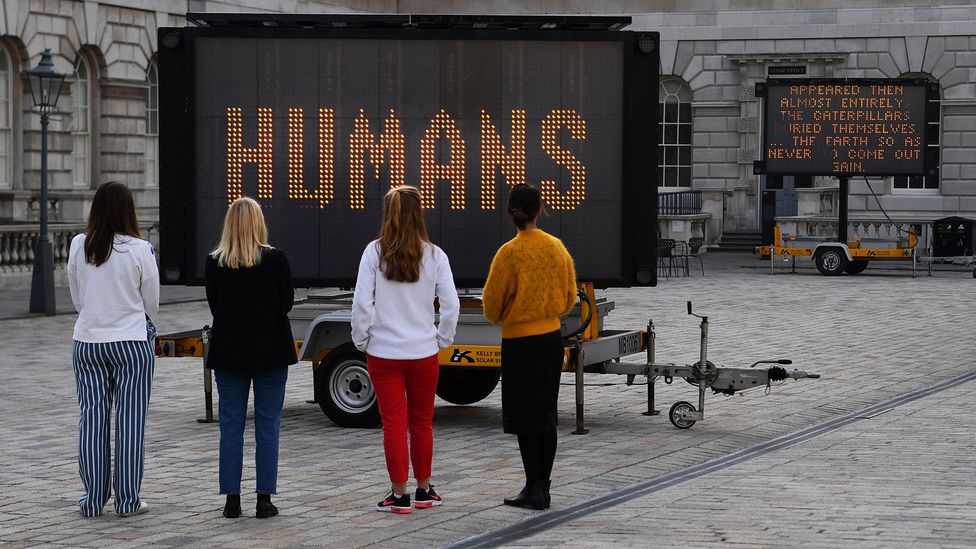
An installation by Justin Brice Guariglia, just 1 of the artists who is creating work that concerns climate change (Credit: EPA)
The identity politics seen in art around the #MeToo and Black Lives Matter movements will grow as environmentalism, edge politics and migration come even more than sharply into focus. Art volition get increasingly diverse and might not 'expect similar fine art' as we wait. In the futurity, once we've become weary of our lives existence visible online for all to meet and our privacy has been all but lost, anonymity may be more than desirable than fame. Instead of thousands, or millions, of likes and followers, we will be starved for actuality and connection. Art could, in plough, go more collective and experiential, rather than individual.
A more inclusive fine art world?
"I imagine fine art in 20 years will exist much more than fluid than it is today," curator Jeffreen M Hayes tells BBC Culture, "in the sense of boundaries existence collapsed between media, between the kinds of art that is labelled art, in the traditional sense. I also see it being much more than representative of our growing and shifting demographics, so more than artists of colour, more female person-identified works, and everything in between."
Hayes'southward exhibition AfriCOBRA: Nation Time was recently selected as an official collateral event of the 2019 Venice Biennale which opens in May, bringing the work of a previously piffling-known and uncelebrated group of blackness artists working on Chicago's south side in the 1960s to an international audience.
"I'm hopeful that in 20 years, every bit art shifts and artists aid to lead the manner, that institutions begin to exist, not just intentional, but more thoughtful nigh the dissimilar ways that art can be presented, and that would require a more inclusive, not simply curatorial staff, but as well leadership," she says.
Senegalese artist and curator Modou Dieng tells BBC Culture "the futurity of art is black." Today, African, African-American, Afro-European, and Afro-Latin art is trending globally, marked by an opening to African diaspora artists working with discourses beyond the black trunk and colonialism. Black abstraction, curating and functioning are all centre stage. Growing up in a newly independent Senegal looking for an identity every bit a people, "we saw migration as the solution, non the problem," says Dieng, whose works are included in the US Department of State'south permanent collection.
Senegalese curator and artist Modou Dieng – seen in 2009 – tells BBC Civilisation "the hereafter of art is black" (Credit: Getty)
The change anticipated past Hayes and Dieng does non interpret to the new emergence of blackness, Latino, LGBT, outsider, feminist and 'other' fine art, as these movements have long histories of their own. But it only ways that they will be further embraced by the markets and the institutions, which volition themselves become more than diverse and informed by histories outside the ascendant, Eurocentric, Western canon.
Activism
Activism-art campaigns are indicative of shifting trends toward accountability, also revealing of entrenched power dynamics and dirty money in the fine art world. Decolonize This Place, an baggy group of artists and activists describing themselves equally an "action-oriented movement centring around Indigenous struggle, Black liberation, gratuitous Palestine, global wage workers and de-gentrification," are currently undertaking protests inside New York's Whitney Museum of Art confronting vice chairman Warren B Kanders, who owns a company that manufactures tear-gas used against oppressed people effectually the world.
The creative person-activists of the Decolonize This Identify movement aren't the first in history to exist disruptive, usually to the dismay of institutions. During Earth State of war 1 a group of artists calling themselves the Dada started to phase disruptive, experimental interventions as a protestation confronting the senseless violence of the war. The Dada was considered the almost radical advanced movement in the early 20th Century, followed past the Fluxus artists in the 1960s, who similarly sought to employ shock and senselessness in club to change artistic and social perceptions. The legacy of these performative movements continues in works past artists like Paul McCarthy and Robert Mapplethorpe. "Shock functions every bit office of the movements' effort to change society," writes Dorothée Brill in Shock and the Senseless in Dada and Fluxus. "This endeavour will be shown to as beingness linked to the artists' rejection of the thought that artistic production must make sense and be meaningful."
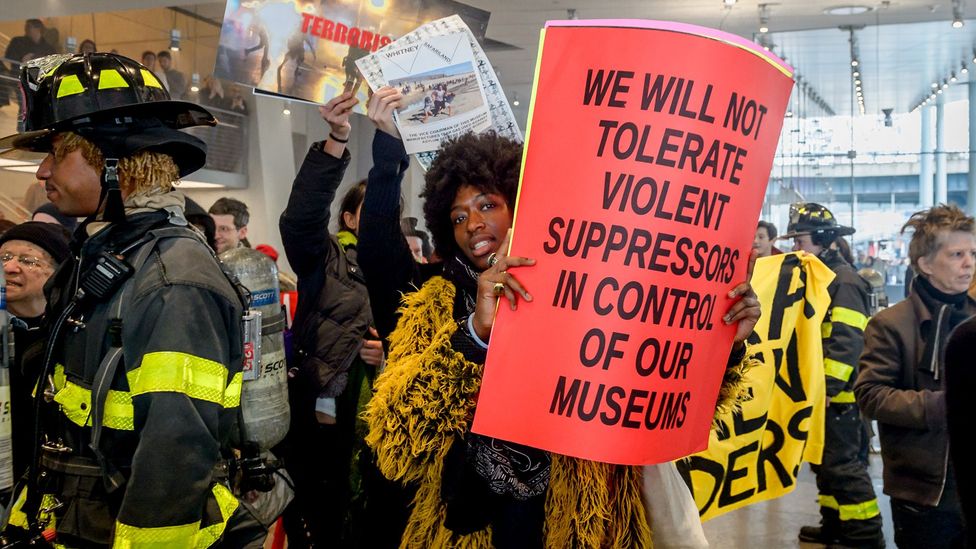
Activists Decolonize This Place protest inside New York'due south Whitney Museum (Credit: Getty)
"I hope that art volition keep to be a space for formal innovation, radical experimentation and lawlessness," curator Chris Sharp tells BBC Civilisation, "in order to continue to evade the instrumentalisation of capitalism, politics and ideology, carving out a space for neither right nor wrong thinking, simply rather idea which tin can be neither qualified nor quantified." When we spoke, Sharp was in Milan for the art fair with his United mexican states City gallery, Lulu, earlier traveling to Venice, where he is co-curating the New Zealand Pavilion for the May Biennale with Dr Zara Stanhope and creative person Dane Mitchell.
Those who believe in 'fine art for art's sake' might say that art as an unquantifiable force must remain exterior social or ideological norms, or take a chance condign something else. Some experts like Abrupt contend that it's a slippery gradient when fine art starts leaning toward activism because that'due south just not the point. (Though the curator also argues that it's impossible for art to be apolitical). It's a viewpoint committed to art as a force on its own, a process of radical experimentation that results in an artwork, i of many along a line of enquiry, not a means to illustrate an end or impregnate an object with meaning. No conclusions should be drawn almost art, present or hereafter because it is the force against universalism, which must be interrupted by artists, as if to tell the world "wake upwards!"
Painting is (not) dead
In two decades' fourth dimension, it will accept been 200 years since Paul Delaroche exclaimed "painting is dead", and there are reasonable arguments against how relevant the medium is as a tool of the avant-garde. Delaroche's original idea has been repeated and recycled incessantly equally new mediums take worked their way into and out of the spotlight, but painting isn't probable to be going anywhere.
Painting sales are even so the major driver of sale houses, art fairs and galleries, dominating all record-breaking art sales. Modernistic paintings made during the first half of the 20th Century continue to hold steady equally the most desirable and most expensive artworks on the market. Nine of the 10 most expensive paintings ever sold were made between 1892 and 1955, the only exception existence a newly discovered Leonardo da Vinci from between 1490 and 1519, which fetched an boggling $450.3m (£341m) at sale, making it the most expensive artwork ever sold. Every painting on the list was made by a white man, notwithstanding, which doesn't pigment a very hopeful picture for equality.
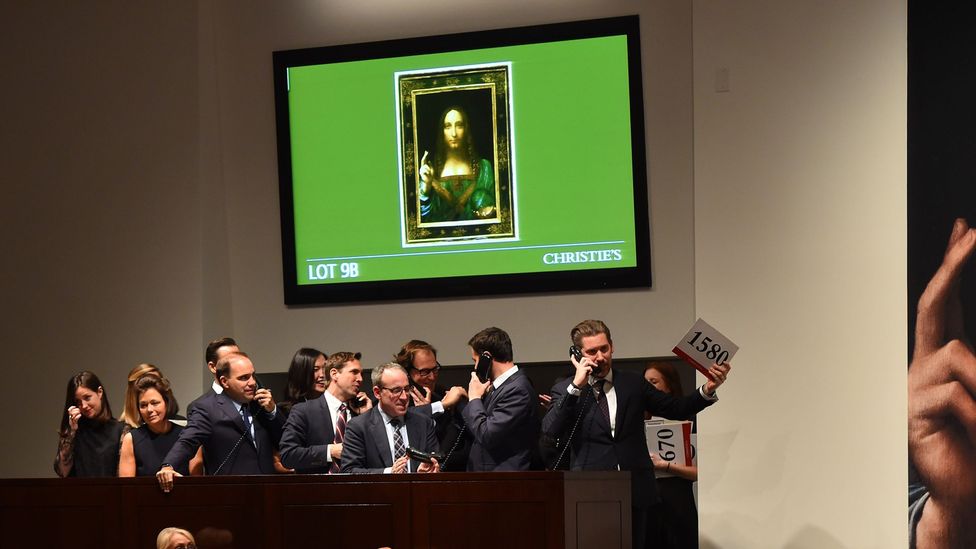
Leonardo da Vinci'due south Salvator Mundi sold at auction in 2017 for over $450m, making it the most expensive painting ever sold (Credit: Getty)
In twenty years, the market might non exist very different than it is today – dominated by modern painting – but mayhap works from the second half of the 20th Century, including more women and minority artists, will begin to accrue value: in 2017 a painting by Jean-Michel Basquiat, Untitled (1984), set a new record for the almost expensive gimmicky artwork sold at auction for $110.4m (£85.4m). Final year the market place for contemporary African and African diaspora also set records, with Kerry James Marshall fetching an astounding $21.1m for his painting Past Times (1997), a new record for living African-American artist.
Multi-futurism
Maite Borjabad, curator of architecture and pattern at The Fine art Institute of Chicago, says that nosotros should be "ready for things to happen that you cannot fifty-fifty anticipate." In other words, we can't wait to predict ane time to come, but instead should set up for many futures.
A museum is non just a place for things to be, merely it'due south a platform for other voices to be heard. So according to Borjabad, the curator is a mediator. Through commissions, for example, the museum isn't just a place to display art, only also an "incubator of ideas" for producing new work. "I think that the time to come is multiple and plural, it's not a future," she tells BBC Culture.
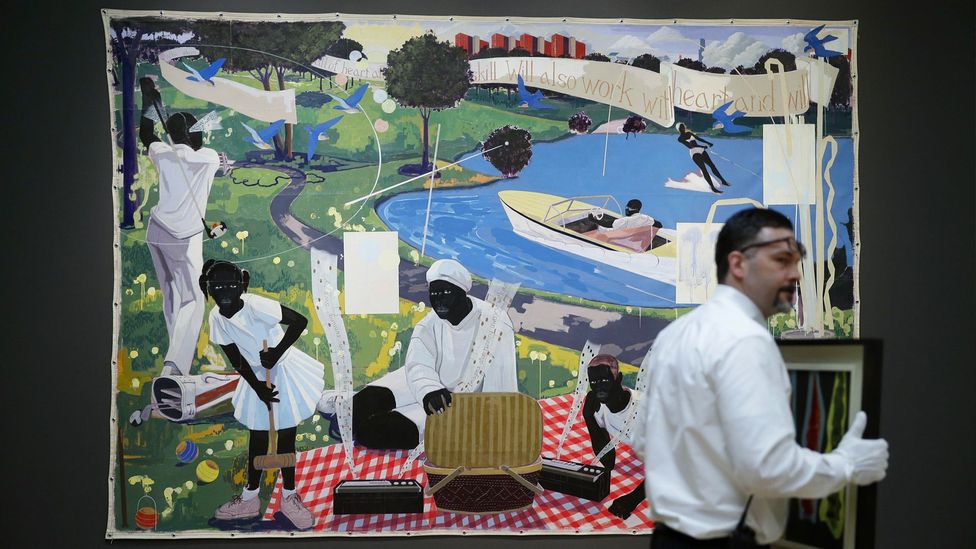
Kerry James Marshall's painting Past Times (1997) sold for $21.1m, a new record for a living African-American artist (Credit: Alamy)
"Cultural institutions and collections are highly political and have perpetuated and consolidated a very dogmatic agreement of history," she continues. "That's why collections like the Art Constitute are the perfect textile to help u.s. rewrite histories, plural, rather than just a history."
In the yr 2040, art might non await like art (unless it's a painting), but it will wait similar everything else, reflecting zeitgeists as multitudinous and diverse as the artists themselves. There will be artist-activists leading political upheaval; in that location will be formal experimenters exploring new mediums and spaces (even in outer infinite), and there will be potent markets in Latin America, Asia and Africa. So in the world of civilization at least, the Due west may find itself playing catch up.
Pb epitome: Lines (57° 59′ Northward, 7° sixteen'W) by Timo Aho & Pekka Niittyvirta in Taigh Chearsabhagh Fine art Centre, Scotland (Credit: Pekka Niittyvirta & Timo Aho)
If you lot would like to comment on this story or annihilation else you have seen on BBC Culture, head over to our Facebook page or message us onTwitter .
And if you liked this story, sign up for the weekly bbc.com features newsletter , called "If You But Read half dozen Things This Calendar week". A handpicked option of stories from BBC
burlingthavengetter.blogspot.com
Source: https://www.bbc.com/culture/article/20190418-what-will-art-look-like-in-20-years
0 Response to "Priceless Art Objects Replaced With a Projection of the Object That Looks Real but Isnt"
Post a Comment